How Much Does a Missed Call Cost a Small Business?
How Much Does a Missed Call Really Cost a Small Service Business?
For a small service business, a missed phone call can be much more than an inconvenience. It can be a lost customer.
Think about how people search for services today. A homeowner discovers a leaking pipe, an air conditioner stops working, a vehicle needs to be towed, or an electrical problem suddenly appears. They search for a local company and start calling.
If the first business doesn't answer, many customers don't leave a voicemail and patiently wait for a return call. They simply call the next company.
For plumbers, HVAC companies, electricians, roofers, contractors, towing companies, auto repair shops, and other service businesses, that means an unanswered phone can directly affect revenue.
The Real Cost of a Missed Business Call
There isn't one universal dollar amount for a missed call because the value of a customer varies dramatically by industry and service.
A missed call could represent a relatively small service appointment—or a customer worth hundreds or thousands of dollars.
Consider a few examples:
A homeowner calling about an HVAC repair
A customer needing emergency plumbing service
A property owner requesting a roofing estimate
A stranded driver looking for a towing company
A homeowner requesting an electrical repair
A prospective customer requesting an estimate for a larger project
The important question isn't simply "How many calls did we miss?"
It's:
"How many potential customers were behind those calls?"
Even a relatively small number of lost opportunities can add up over the course of a month or year.
Why Customers Don't Always Leave Voicemails
Voicemail used to be the standard backup when a business couldn't answer.
Customer expectations have changed.
When someone needs a service—particularly an urgent one—they may be contacting several businesses at once. Their goal isn't necessarily to speak with one particular company. Their goal is to get their problem solved.
Imagine a homeowner discovers water spreading across the kitchen floor.
They call a plumbing company.
No answer.
They hear:
"Please leave a message after the tone."
Instead of waiting, they call another plumber.
The second company answers.
At that point, the first plumbing company hasn't merely missed a phone call. It may have lost the job.
Why Service Businesses Are Especially Vulnerable to Missed Calls
Small service businesses face a difficult problem: the people responsible for generating revenue are often the same people expected to answer the phone.
A plumber may be underneath a sink.
An HVAC technician may be servicing equipment.
An electrician may be working in a panel.
A contractor may be on a jobsite.
A towing operator may be driving.
Stopping what you're doing every time the phone rings isn't always practical—or safe.
Hiring a full-time receptionist can solve part of the problem, but that introduces another significant expense for a small business. It also doesn't automatically solve after-hours, overflow, weekend, or simultaneous-call coverage.
That's why businesses increasingly look at alternatives such as answering services and AI receptionists.
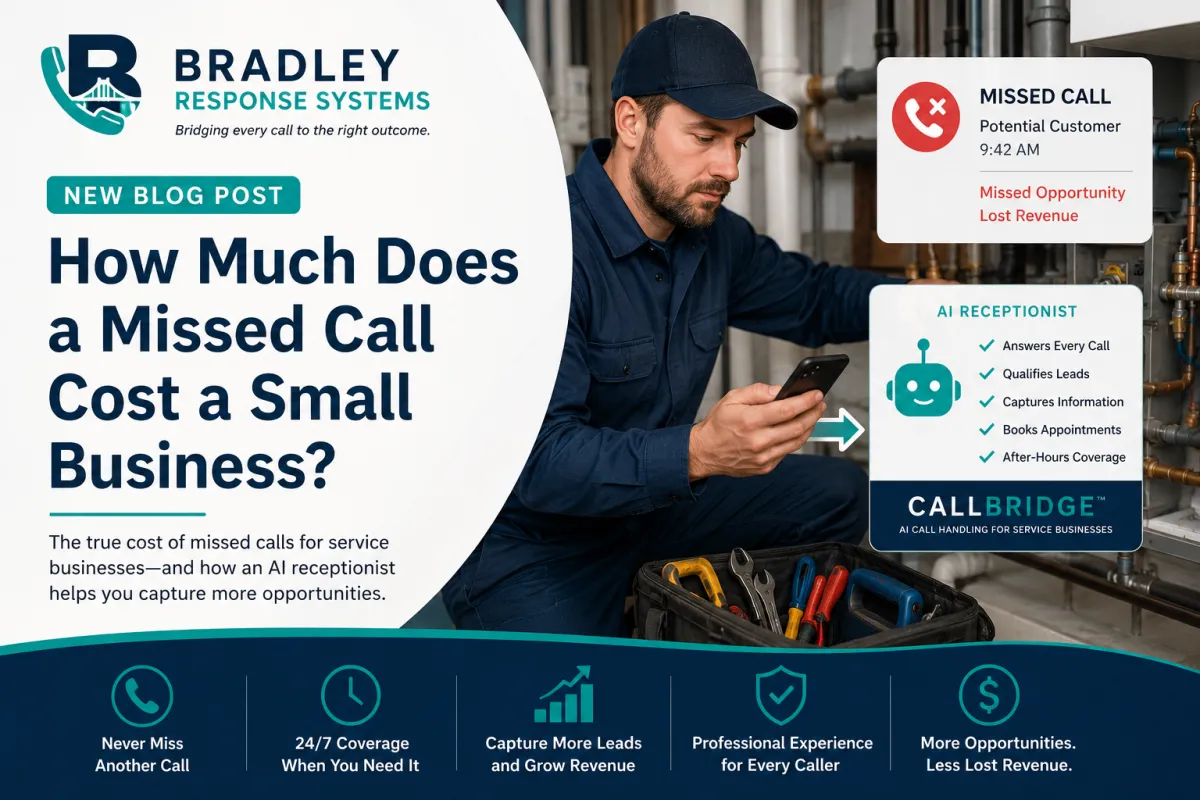
What Is an AI Receptionist?
An AI receptionist is a voice-based system designed to interact with callers using natural conversation.
Depending on how the system is configured, an AI receptionist can help:
Answer calls when employees are unavailable
Provide basic business information
Determine why someone is calling
Capture the caller's contact information
Qualify potential leads
Route or transfer appropriate calls
Assist with appointment scheduling
Handle after-hours inquiries
Record information for business staff to review
The goal isn't necessarily to prevent employees from answering their phones.
For many businesses, the better approach is to let staff answer normally when they're available and use the AI receptionist as a backup when they aren't.
AI Receptionist vs. Voicemail
The biggest difference is interaction.
Voicemail: The caller is asked to leave information and wait for someone to respond.
AI receptionist: The caller can immediately interact with a system designed to understand why they're calling and take an appropriate next step.
That difference can matter when a potential customer is deciding whether to wait or call another company.
AI Receptionist vs. Traditional Answering Service
Traditional answering services can also solve the missed-call problem, and human operators remain a good solution for some businesses.
AI receptionists offer a different approach.
They can provide consistent coverage without requiring a business to staff every hour itself. They can also be configured around the company's specific services, hours, routing preferences, frequently asked questions, and scheduling process.
The right choice depends on the business.
The important thing is making sure valuable calls aren't simply disappearing into voicemail.
What About After-Hours Calls?
After-hours calls can be particularly valuable for certain service businesses.
A homeowner with no heat, a broken air conditioner, a plumbing emergency, or a disabled vehicle may not wait until the next morning.
That creates an unusual situation for small businesses.
You don't necessarily need someone sitting beside the phone all night—but you may still want someone, or something, available when a potential customer calls.
An AI receptionist can provide another layer of coverage outside normal business hours and collect the information the business needs to determine what happens next.
How CallBridge Approaches Missed Calls
Bradley Response Systems developed CallBridge around a simple idea:
A business shouldn't have to choose between doing the work and answering the phone.
CallBridge can be configured to complement the way a business already operates.
During normal business hours, employees can continue answering calls themselves. When they're busy, unavailable, working with another customer, or unable to answer before the call would otherwise reach voicemail, CallBridge can step in.
Businesses can also choose different call-handling arrangements based on their individual needs.
The objective isn't to replace the relationship between a business and its customers.
It's to help bridge the gap when nobody is available to answer.
How Many Missed Calls Would It Take to Matter?
A useful way to evaluate missed calls is to think in terms of opportunity value.
Suppose a business misses several legitimate prospective-customer calls each week.
Not every caller would have become a customer. Some may be spam, existing customers, vendors, price shoppers, or people looking for something the company doesn't provide.
But some will represent real opportunities.
If recovering just one additional customer generates enough gross profit to cover the monthly cost of better call handling, then improving call coverage may already make financial sense.
That's why businesses should evaluate more than the number of calls they receive.
Consider:
Number of missed calls × percentage that are legitimate prospects × average value of a converted customer
That provides a much more useful picture of what missed calls may actually be costing the business.
Five Questions Every Service Business Should Ask
Take a look at your own call-handling process:
What happens when nobody answers the business phone?
How many legitimate calls reach voicemail each week?
How quickly are those callers contacted afterward?
What is an average new customer worth?
What happens when someone calls after normal business hours?
If you don't know the answers, that's useful information by itself.
Missed-call tracking can help identify whether phone coverage is actually costing the business opportunities.
The Goal Isn't to Answer More Calls. It's to Capture More Opportunities.
Technology by itself isn't the objective.
Customers are.
For a small service business, the phone remains one of the most direct connections between someone who needs help and the company capable of providing it.
When that connection fails, the customer may move on.
Better call handling—whether through employees, a traditional answering service, an AI receptionist, or a combination of approaches—can help close that gap.
Every call won't become a customer. But a customer can't choose your business if they never reach you.
Want to See How CallBridge Handles a Real Call?
Bradley Response Systems helps service businesses handle calls when they're busy, unavailable, after hours, or out in the field.
CallBridge is designed to bridge every call to the right outcome.
Visit Bradley Response Systems to learn more or book a CallBridge demonstration.