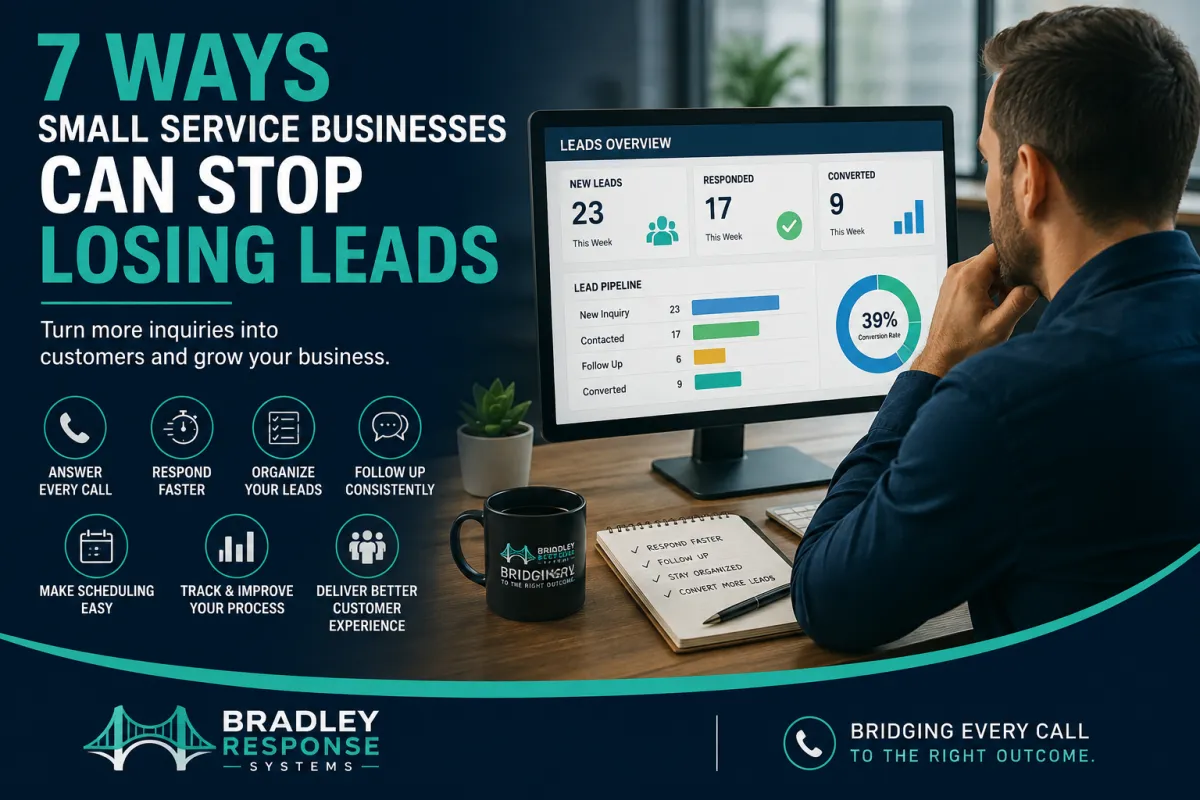
7 Ways Small Service Businesses Can Stop Losing Leads
7 Ways Small Service Businesses Can Stop Losing Leads
Getting someone interested in your business is only the beginning. The next challenge is making sure that potential customer doesn't disappear before becoming an actual customer.
For plumbers, HVAC companies, electricians, contractors, roofers, auto repair shops, restoration companies, and other service businesses, leads can come from many places: phone calls, Google searches, referrals, website forms, social media, and repeat customers.
The problem is that generating more leads won't necessarily grow a business if too many existing opportunities are being lost along the way.
Before spending more money on advertising, it can be worth looking at what happens after a potential customer reaches out.
Here are seven practical ways small service businesses can reduce lost opportunities.
1. Make It Easy for Customers to Contact You
Customers shouldn't have to search through your website to figure out how to reach you.
Your phone number, contact form, and other important contact options should be easy to find—especially on a mobile device.
For service businesses, this matters because many customers are searching from their phones when they already need help.
A homeowner with a plumbing leak probably isn't interested in exploring ten pages of a website. They want to know:
Do you provide the service I need?
Do you serve my area?
How do I contact you?
When can someone help me?
Your website should make those answers easy to find.
Your Google Business Profile, social-media profiles, directories, and other online listings should also contain accurate contact information.
Every unnecessary step between "I need help" and "I've contacted the business" creates another opportunity for the customer to leave.
2. Have a Plan for Calls You Can't Answer
For many service businesses, answering every phone call immediately simply isn't realistic.
The owner may be driving.
A technician may be working with a customer.
Everyone may already be on another call.
The business may be closed for the evening.
The important thing is deciding what should happen before that situation occurs.
Depending on the business, that might include voicemail, call forwarding, an answering service, an AI receptionist, or another call-handling process.
The right solution will vary.
What matters is avoiding a situation where nobody has thought about what happens when the phone rings and the team can't answer.
This is particularly important for urgent services. Someone with no heat, a leaking pipe, an electrical problem, or a disabled vehicle may continue calling businesses until someone responds.
A missed call isn't automatically a lost customer—but the longer a caller goes without a response, the greater the opportunity for another company to win the job.
3. Respond to New Leads Quickly
Speed matters.
Imagine a homeowner submits estimate requests to three contractors.
The first responds within several minutes.
The second responds later that afternoon.
The third responds the following day.
Even if all three companies provide excellent work, the first business has an immediate advantage because it has already started the conversation.
Fast response doesn't necessarily mean providing an estimate immediately.
Sometimes a simple acknowledgment is enough:
We received your request. Here's what happens next.
That reassures the customer that their inquiry didn't disappear.
Businesses can improve response times through better internal processes, automated confirmations, CRM notifications, scheduling tools, or simply assigning responsibility for checking new inquiries.
The goal isn't to automate every conversation.
It's to make sure legitimate opportunities don't sit unnoticed.
4. Keep Lead Information in One Place
A phone number written on a piece of paper.
A Facebook message.
An email.
A website form submission.
A text message.
A note saved on someone's phone.
Individually, none of these seems like a major problem. But as a business grows, scattered customer information makes follow-up much harder.
A basic customer relationship management system—or CRM—can help organize inquiries in one place.
At minimum, a useful lead record might contain:
Customer name
Phone number
Email address
Service requested
Date of inquiry
Current status
Last contact
Next action
The technology doesn't need to be complicated.
The important part is knowing who contacted the business and what needs to happen next.
Without that visibility, promising leads can easily be forgotten.
5. Follow Up Without Becoming Annoying
Not every customer makes a decision during the first conversation.
Someone requesting a roofing estimate may need time to compare options.
A homeowner considering a larger project may need to discuss it with a spouse.
A commercial customer may need approval.
That doesn't necessarily mean the lead is dead.
A simple follow-up process can recover opportunities that otherwise would have been forgotten.
The key is making the follow-up useful rather than excessive.
For example:
After an estimate: Confirm that the customer received it.
A few days later: Ask whether they have any questions.
After an appointment: Confirm the next step.
After completed work: Ask whether everything was handled satisfactorily.
Some of these communications can be automated, while others are better handled personally.
Automation should support good customer service—not turn every lead into an endless sequence of messages.
6. Make Booking the Next Step Easy
Once a customer decides they want service, don't make the next step unnecessarily difficult.
If appropriate for the business, online scheduling can allow customers to request or book appointments without waiting for someone to call them back.
For other businesses, scheduling may require a conversation because the company needs to understand the problem first.
Either approach can work.
What matters is having a clear path from:
Interested → Qualified → Scheduled
If customers repeatedly hear:
"Someone will get back to you eventually,"
some of them will continue searching.
Clear scheduling expectations can prevent that.
Tell customers what happens next and, when possible, when they should expect it to happen.
7. Measure Where Leads Are Being Lost
One of the easiest mistakes is assuming the business simply needs more leads.
Sometimes it does.
But sometimes the business already receives enough opportunities and simply isn't converting enough of them.
Look at the entire process:
How many people call?
How many calls go unanswered?
How many website inquiries receive a response?
How quickly are new leads contacted?
How many estimates are sent?
How many estimates become jobs?
How many prospects never receive follow-up?
Those numbers can reveal where the actual problem exists.
For example, increasing advertising may not accomplish much if the business already misses a significant portion of the calls generated by its current advertising.
Improving the process can sometimes be more valuable than simply putting more people into the top of the funnel.
Start With the Leads You Already Have
Lead generation gets a lot of attention because new customers are essential to growth.
But there are really two separate challenges:
Generating opportunities and capturing the opportunities you've already generated.
Small improvements throughout the customer journey can compound.
Make contacting the business easier.
Have a plan for unanswered calls.
Respond quickly.
Keep customer information organized.
Follow up appropriately.
Make scheduling straightforward.
Measure what happens to your leads.
None of those changes alone guarantees growth.
Together, however, they create a much stronger system for turning interest into actual business.
Before spending another dollar trying to generate more leads, ask a simpler question:
Are we making the most of the leads we already have?
Don't Let the Phone Become a Weak Point
For businesses where unanswered calls are one of those gaps, Bradley Response Systems offers CallBridge, an AI call-handling solution designed to provide coverage when a team is busy, unavailable, after hours, or working in the field.
It's one option among several for improving a business's call-handling process—the important thing is having a reliable process in place before the next customer calls.